.png)
About the University of Birmingham
The University of Birmingham is a leading research-intensive university that recently rose to 68th in the QS World University Rankings. Its College of Medicine and Health, the largest of the University’s five colleges, has more than 1,700 staff and ten research facilities supported by around 30 specialists, managers and academic leads.
A Stratocore customer since 2013, Birmingham now uses PPMS across more than 30 core facilities, managing over 500 instruments throughout the University.
Adriana Flores-Langarica, Research Facilities Manager in the College of Medicine and Health, has experienced PPMS from multiple perspectives. She began as Birmingham’s fourth PPMS user while working as a postdoctoral researcher, later becoming a flow cytometry specialist, facility administrator and super admin. She now acts as a system owner for the University.
Supporting Birmingham’s Research Facility Strategy
At Birmingham, research facilities are managed around four connected priorities:
Access: reducing barriers and helping researchers use shared facilities effectively
Data generation: enabling valuable research data to be produced quickly and efficiently
Compliance: maintaining legal, ethical and quality standards while reducing organisational risk
Financial sustainability: improving operational efficiency and supporting the long-term viability of services
Birmingham already used PPMS extensively for equipment booking, training management, document management, orders, financial processing, invoicing, journal generation, reporting and statistics.
The new PPMS Catalogue presented an opportunity to connect this operational information through a central, searchable resource. As an early adopter of the feature, Birmingham is demonstrating how the Catalogue can support all four strategic priorities rather than serving only as an equipment directory
Why Birmingham Implemented the PPMS Catalogue
Before the Catalogue, finding specialist equipment often depended on local knowledge.
A researcher might approach one facility, be directed to another contact and then be referred elsewhere before finding the right instrument or expertise. Even facility managers did not always know what equipment was available beyond their immediate area.
The Catalogue was introduced to solve two related challenges.
For researchers, it would provide a single place to discover facilities, equipment, services and technical expertise across the University.
For facility managers and senior leaders, it would provide a clearer view of equipment availability, lifecycle information, incidents and operational risk.
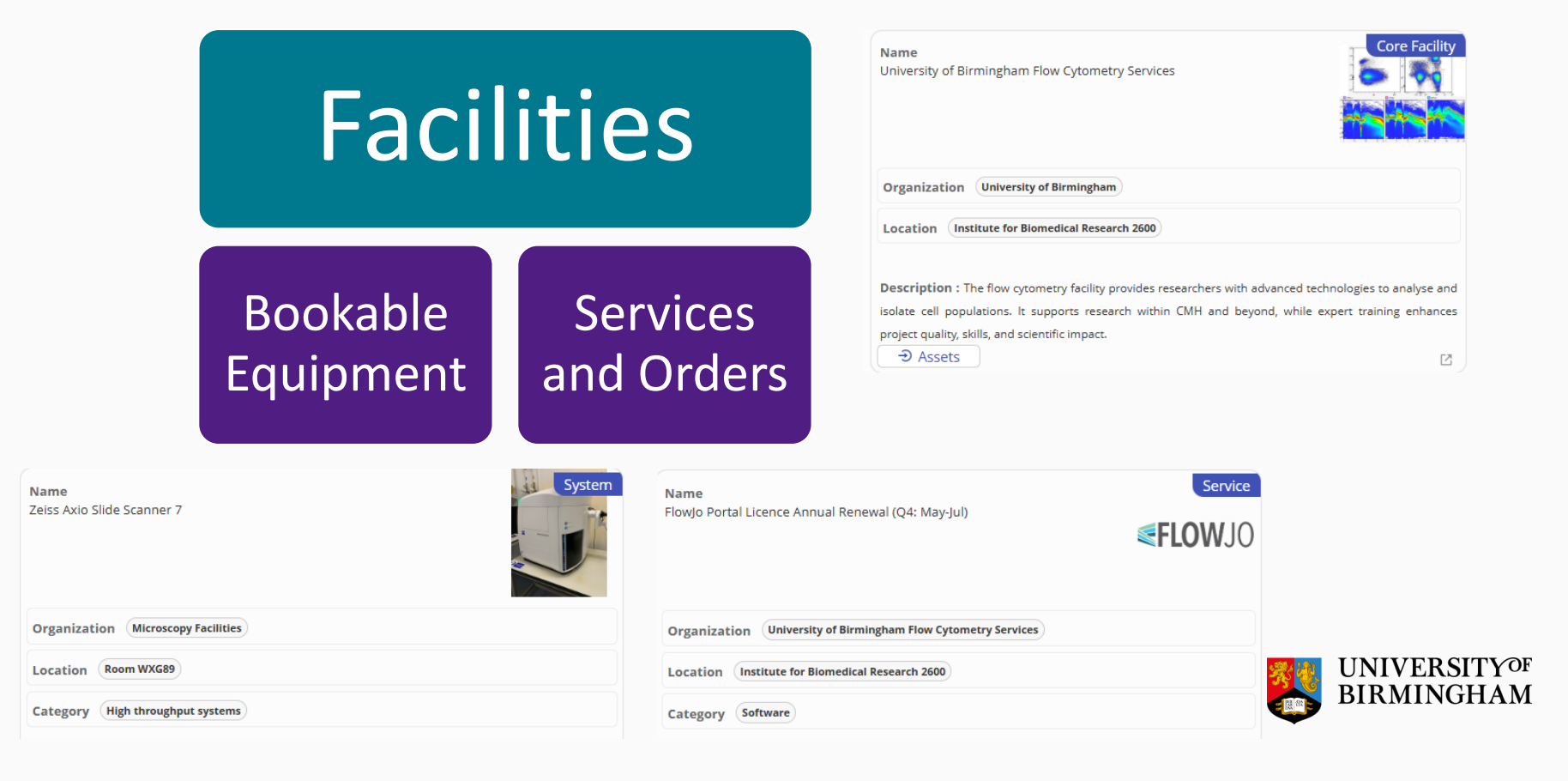
The Catalogue can showcase three connected levels of Birmingham’s research infrastructure:
research facilities
bookable equipment
services and orders
Researchers can search by equipment type even when they do not know which facility owns the instrument. Once they find it, they can see where it is managed, who to contact and how to begin the access or training process.
“Having a unified database that everyone could search has been a very powerful tool.” — Adriana Flores-Langarica, Research Facilities Manager, Infrastructure and Facilities, College of Medicine and Health
Preparing the Data for a University-wide Catalogue
Birmingham began implementing the Catalogue in Autumn 2025.
Although the user-facing experience is simple, significant preparation was needed behind the scenes. More than a decade of PPMS use meant the database contained legacy information, including inactive equipment, inconsistent categories and multiple versions of the same location.
For example, a building and room might have been entered in several different formats. Each variation was treated as a separate location, making it difficult to build a consistent institutional view.
Birmingham used the implementation as an opportunity to improve data governance by:
creating a standard location tree based on approved Estates terminology
consolidating equipment categories across facilities
identifying and cleaning inactive or duplicated records
establishing consistent structures for future equipment entries
Adriana estimates that preparing the location and category structures took around two to three months while she was also managing her usual responsibilities. Once those foundations were established, responsibility for maintaining lifecycle information could be shared with facility administrators.
This preparation delivered value beyond the Catalogue itself. Drop-down structures now reduce duplication, improve consistency and make it easier for facilities to register new equipment correctly.
“The hard work goes into the super admin. Once those trees are built, everything becomes much easier.” — Adriana Flores-Langarica, Research Facilities Manager, Infrastructure and Facilities, College of Medicine and Health
Helping Researchers Find the Right Equipment
The Catalogue gives researchers much more than a list of instruments.
Birmingham is enriching equipment records with:
photographs
facility and location information
technical contacts
instrument specifications
associated services
booking access
relevant equipment capabilities
For microscopy equipment, researchers can review available detectors, optics and experimental configurations before contacting the facility. Flow cytometry records can include lasers and compatible fluorochromes, helping users assess whether an instrument is suitable for their experiment.
The inclusion of technical staff is particularly important. Finding an instrument is only the first step. Researchers also need to know who can provide training, advise on experimental design and guide them through the access process.
The Catalogue connects equipment discovery directly with the specialists responsible for supporting it.
Adriana gave the example of a researcher asking whether Birmingham had an atomic force microscope. She was able to search the Catalogue, identify two instruments she had not previously known were available and direct the researcher to the relevant facilities and staff.
This turns equipment that might otherwise remain hidden within one part of the University into a discoverable resource for a much wider research community.
Turning Lifecycle Data into Strategic Insight
The Birmingham team quickly recognised that the Catalogue could support much more than equipment discovery.
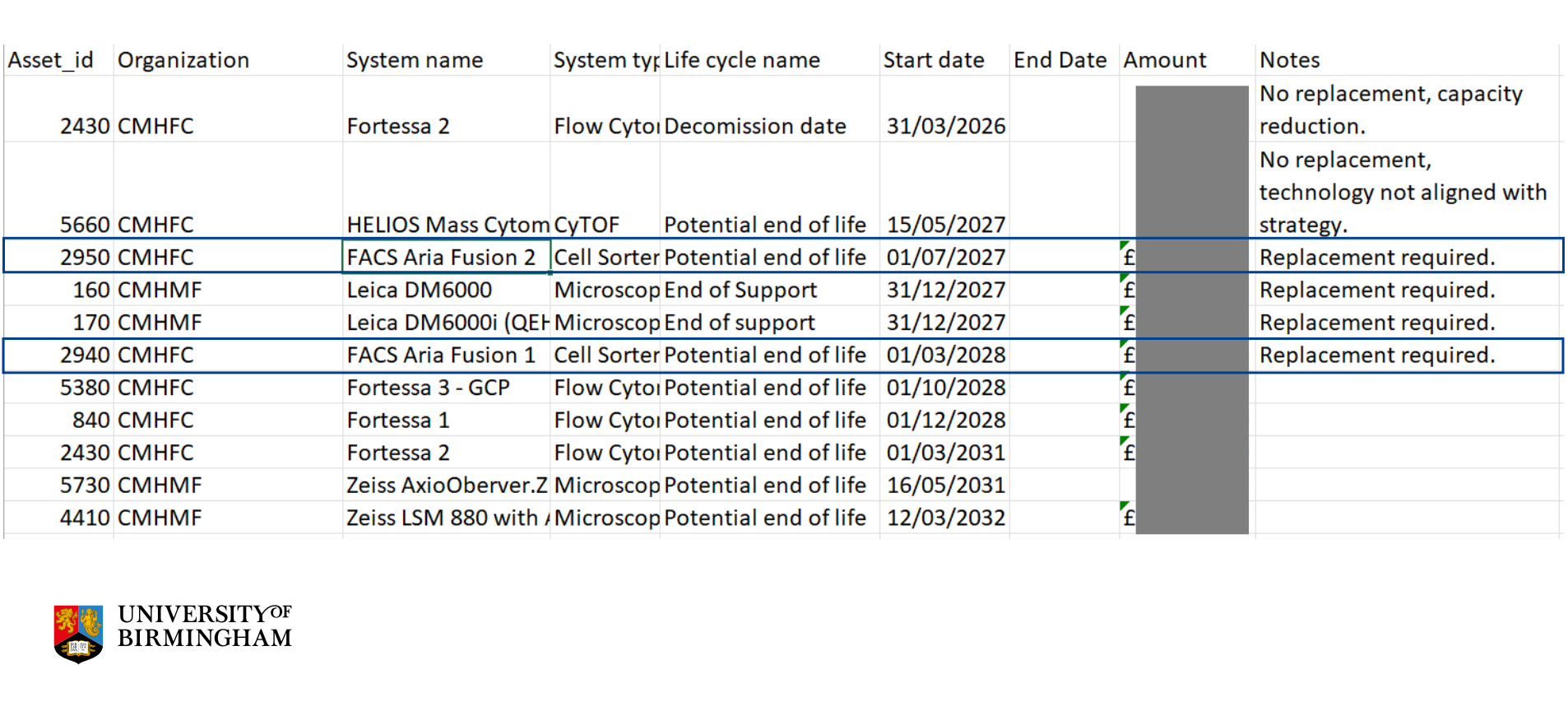
Each equipment record can include flexible lifecycle information defined by the University, including:
purchase and installation dates
purchase order references
service contract details
contract start and end dates
financial values
anticipated end-of-life dates
replacement plans
incidents and interventions
This brings information that was previously distributed across spreadsheets and local records into one accessible system.
The College now uses lifecycle reports to support discussions with Finance about future investment. These reports are reviewed twice during each financial year, helping the team identify upcoming replacement needs and plan budget provision.
Importantly, replacement decisions are not based on equipment age alone.
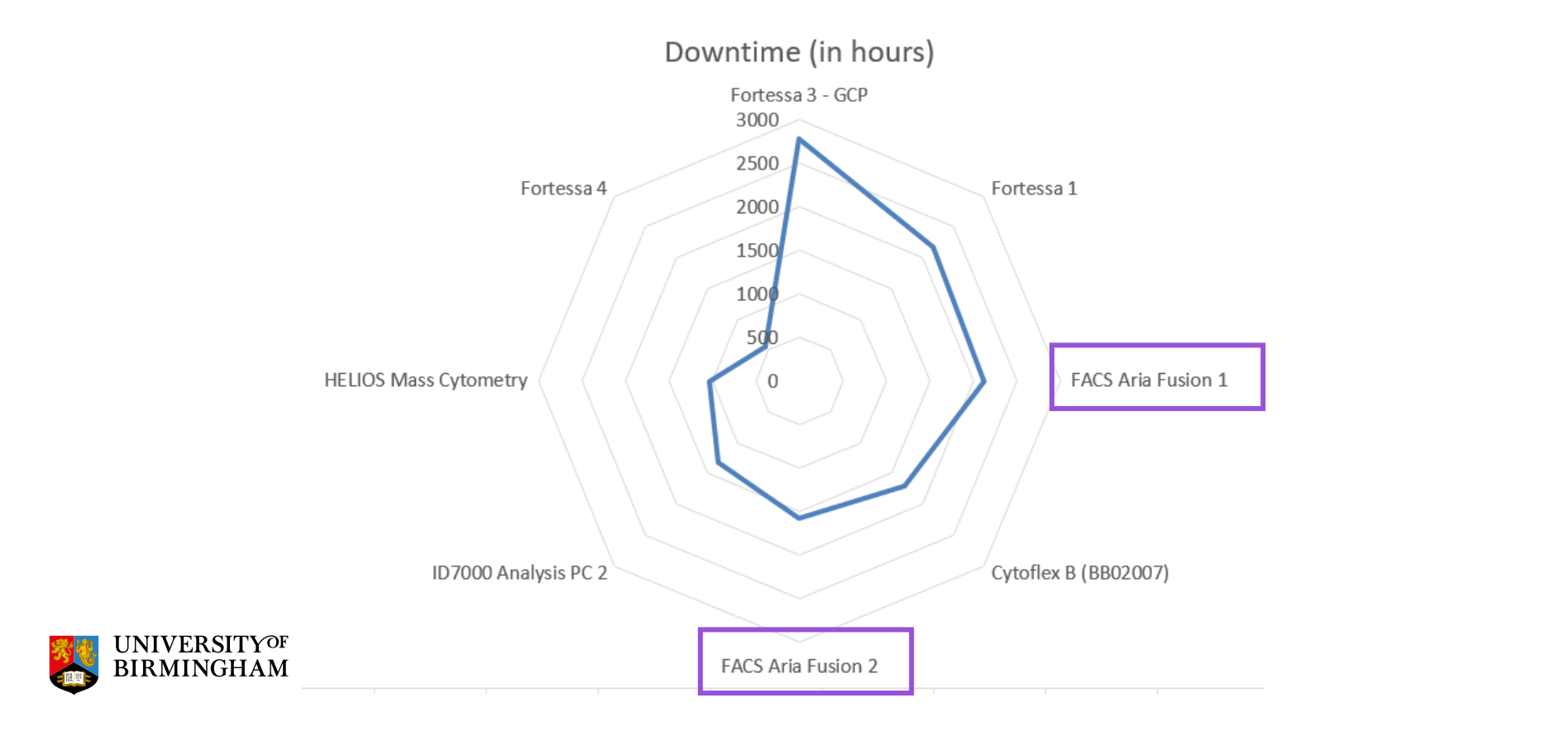
Birmingham combines lifecycle information with PPMS reports on incidents and downtime. An older instrument may still be reliable, while a newer one may experience repeated failures and have a greater operational impact.
“We’re using information from those two reports to take strategic decisions about what we replace and when.” — Adriana Flores-Langarica, Research Facilities Manager, Infrastructure and Facilities, College of Medicine and Health
This gives Finance a more complete picture of equipment need, helping distinguish between instruments that should be replaced, those that should be decommissioned without replacement and technologies that no longer align with institutional priorities.
Creating Value Beyond Research Facilities
As the Catalogue developed, Birmingham identified use cases that extend well beyond researchers and facility managers.
Supporting Finance
Lifecycle reports help Finance anticipate replacement requirements, plan capital budgets and understand which investments should be prioritised.
Purchase order references can also be stored with equipment records, making important financial information easier for facility staff to find.
Supporting IT
Birmingham is registering computers connected to scientific instruments as associated assets.
These computers can otherwise sit outside standard IT inventories because they are supplied and managed as part of an instrument rather than as conventional university devices.
Recording them in PPMS gives IT greater visibility of how many equipment-linked computers exist, where they are located and who is responsible for them. This is particularly useful for major technology changes such as operating system upgrades.
Supporting Insurance and Risk Management
The University is also developing a PPMS report to support equipment insurance.
Because locations are now structured using approved Estates terminology, equipment values can be grouped by building and potentially by floor. This could give insurance teams a more reliable view of high-value equipment at each location.
The report was still being developed at the time of Adriana’s presentation, but it illustrates how structured Catalogue data can support needs that were not part of the original implementation plan.
Balancing Visibility with Data Governance
Making equipment easier to discover also raised questions about which information should be visible and to whom.
Birmingham initially chose to keep its full Catalogue available to authenticated University users while facilities reviewed their records and became comfortable with the information being shared.
Some teams were initially cautious about publishing services or equipment details. These concerns could often be addressed by explaining that much of the information was already available across separate facility websites. The Catalogue simply presented it more consistently and made it easier to find.
There were also legitimate security considerations. When Adriana raised concerns that the public Catalogue could expose the precise location of sensitive equipment, Stratocore updated the visibility controls quickly.
This allowed Birmingham to retain the discovery benefits of the Catalogue while taking a measured approach to location and access information.
A Collaborative Implementation
The implementation required close collaboration between Adriana, facility administrators, University teams and Stratocore.
Adriana established the central location and category structures, then trained facility administrators to populate lifecycle records for their own equipment. Sharing responsibility across the facilities made the project manageable and helped embed ownership of the information.
Stratocore’s technical support team also worked with Birmingham throughout the implementation, helping resolve data issues, develop reports and respond to feedback on the new feature.
Adriana highlights the support provided by Stratocore, noting that the Catalogue could not have been implemented without the contribution of both Stratocore's technical team and Birmingham’s facility staff.
“What is great about Stratocore is their responsiveness to feedback.” — Adriana Flores-Langarica, Research Facilities Manager, Infrastructure and Facilities, College of Medicine and Health
Looking Ahead
At the University of Birmingham, the PPMS Catalogue is becoming much more than a directory of research equipment.
It is helping researchers discover facilities, compare technical capabilities and connect with specialist staff. It is giving facility managers a more complete view of their equipment and making lifecycle information easier to maintain. It is also supporting Finance, IT, Estates and insurance teams with information for investment planning, technology management and organisational risk.
The project demonstrates the wider potential of the new PPMS Catalogue. By connecting discoverability with structured lifecycle and operational data, institutions can unlock more value from the research infrastructure they already own.
Birmingham’s experience also shows that implementation is not simply a matter of publishing an existing asset list. Its long-term value depends on clear data structures, shared ownership and collaboration between the teams that manage, support and invest in research equipment.
The University expects further applications to emerge as the Catalogue continues to develop:
“I think we will discover new ways for how the Catalogue is useful.” — Adriana Flores-Langarica, Research Facilities Manager, Infrastructure and Facilities, College of Medicine and Health
If you would you like to how Stratocore can help your organisation have a catalogue to better manage and showcase your research infrastructure please get in touch.
Related Content
Case Studies

Inside the University of Birmingham’s PPMS Catalogue Rollout: Searchable Assets, Smarter Decisions
The Stratocore PPMS Catalogue at the University of Birmingham helps researchers discover equipment, services and expertise while turning data into insights for planning, budgeting and risk management....
Case Studies
The Cancer Research UK Cambridge Institute Partners with Stratocore to Enhance Core Facility Management
The keys to a successful PPMS implementation...

Case Studies
How TRI Leverages PPMS Data to Drive Strategic Research Infrastructure Management
How The Translational Research Institute (TRI) turns Stratocore PPMS usage and performance data into powerful insights: shaping decisions around staffing, equipment investment and long-term planning....